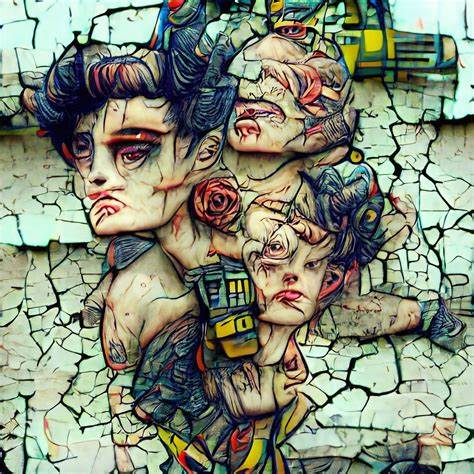
In recent years, generative art has been gaining ground in galleries, museums and, above all, in the imagination of artists and collectors. But what defines this form of artistic creation? What's more, can it be classified as contemporary art or are we facing a new category that requires a different understanding?
I decided to write this article because as a traditional artist, who uses paint on canvas, I believe that the most archaic way of being an artist, where it all began... maybe not the most, because it all begins with nature's paints and cave walls.... But on the other hand, I'm a specialist in communication, marketing and technology and I was curious about how generative art could fit into our artistic universe.
Without wishing to be repetitive, but of course, I realize that I've already talked about this in the article on art and technology in times of AI. I recommend reading it too!
But the fact is that at the end of my research and reflections, which I'm going to share with you in the next few paragraphs, I've concluded that it's nothing more than a tool for making art! Pure art!
That's because it's just another way of exploring the act of making art... and from there, with all the poetic freedom I have, being an artist as well as a journalist and publicist, I dare say that it's like lithography, we're just going to replace the stones with computers.
Now read to the end and draw your own conclusions! ; )
What is generative art?
Generative art is art created from autonomous systems. This can include algorithms, artificial intelligence, simulation software, or even mathematical and physical rules. The role of the artist, in this case, is more of an orchestrator of possibilities to arrive at a result that is satisfactory to the eye or soul. The artist conceives the work, defines the parameters, uses platforms that enable him to realize his creations and is often surprised by the results! : o
Examples of generative art

- Works made with code algorithms
Example: visual patterns that constantly change, such as fractals, mosaics or organic shapes that multiply and transform based on mathematical formulas. - Artificial Intelligence that generates unique images
Example: the use of AI such as DALL-E, Runway, or Artbreeder to create portraits, landscapes and scenes that don't exist in the real world. - Interactive works with sensors and real-time data
Examples: installations that change color or shape when the public is present, or that use data such as heartbeats, climate, ambient sound, etc. - Generative NFTs with embedded code
Example: "Fidenza" by Tyler Hobbs - a series of algorithmically generated artworks, each one unique, minted directly on the blockchain. - Generative music
Example: systems that create musical compositions in real time, based on rules established by the artist.
Renowned artists of generative art
- Harold Cohen - pioneer with the AARON system, one of the first AIs to create visual artworks autonomously since the 1970s.
- Casey Reas and Ben Fry - creators of the Processing programming language, widely used in generative visual art. Reas also creates works with algorithms and artificial intelligence.
- Mario Klingemann - German artist who works with neural networks, machine learning and AI. His works mix technology and distorted human portraits.
- Refik Anadol - known for transforming data and artificial intelligence into large-scale immersive audiovisual installations.
- Tyler Hobbs - author of the Fidenza series, one of the greatest successes of generative art in NFTs. His works explore form, texture and color with algorithms he created himself.
- Sofia Crespo - an artist who mixes biology and artificial intelligence, creating digital creatures and ecosystems inspired by the natural world.


Making generative art can be simpler than it seems - especially today, with accessible tools. Below are three practical ways to get started, from the most technical to the most intuitive:
1. Using no-code tools (without programming)
Perfect for those just starting out:
- Artbreeder (https://www.artbreeder.com/) - mixing images with AI, ideal for portraits and surreal landscapes.
- Runway ML (https://runwayml.com/) - easy-to-use visual creation platform with AI and generative models.
- Playform (https://www.playform.io/) - a mix of traditional art and generative algorithms, great for visual artists.
- Wombo Dream or NightCafe - apps for creating unique images from text.
2. With creative programming (intermediate level)
If you want to dig deeper and create your own algorithms:
- Processing - visual programming language, widely used in generative art.
- p5.js - JavaScript-based version, ideal for web interactions.
- TouchDesigner - software for interactive installations, visual music and real-time art.
3. Mixing physical art + AI
You can scan or photograph your handiwork and then apply algorithms to it:
- Collect
- Analyzing patterns
- Recreating shapes
- Animate with AI (such as Kaiber, Runway or After Effects with AI plugins). Find out more here!
Extra tip to get started without fear
Choose one of these approaches and make an experimental series with a theme that moves you. You are in control: even with the help of the machine, sensitivity remains human.
The poetics of the unpredictable
There is something profoundly poetic about generative art: the surrender to controlled chance. Each work can be unique, even if it obeys the same rules. This unpredictability doesn't eliminate authorship - it just reinvents it. The artist becomes a curator of algorithms, an interpreter of the machine itself, a mediator between the rational and the sensitive.
Is Generative Art contemporary art?
Yes and no. Generative art certainly dialogues with the central themes of contemporary art: the role of technology, the questioning of authorship, interactivity, and even the ephemeral. But some argue that it ushers in a new era - not just a movement within contemporary art, but a broader cultural turning point.
Artificial intelligence, for example, is just a tool: can it change the very notion of creation? If the artist is lazy! Just as has happened with texts, where people are asking AI to write, then don't read what they get and pass it on....
This can also happen with art. But there is a big difference: the art will represent the artist, so his decision on the results is the basis or the very work of art that he will deliver to the market and this defines his artistic style and personality.
Is generative art a new field or an extension?
Perhaps generative art doesn't need to be "fitted" into a fixed definition. It is, by nature, fluid, changeable and open to experimentation. Instead of asking "is it contemporary art?", we can ask: how does it broaden the field of art? What does it make us feel, think or question? What new ethics, aesthetics and poetics does it propose?
Maybe in the future we'll see it differently
In an increasingly digital world, generative art is not only a reflection of our times - it is also a provocation. It makes us think about authorship, about collaboration between humans and machines, and about the limits (or lack thereof) of artistic creation.
Perhaps in the future, when we look back, generative art will be remembered not as a style, but as a symptom of transition - the moment when art stopped being just made by human hands and truly became a dialog between the creation and its creator! lol


